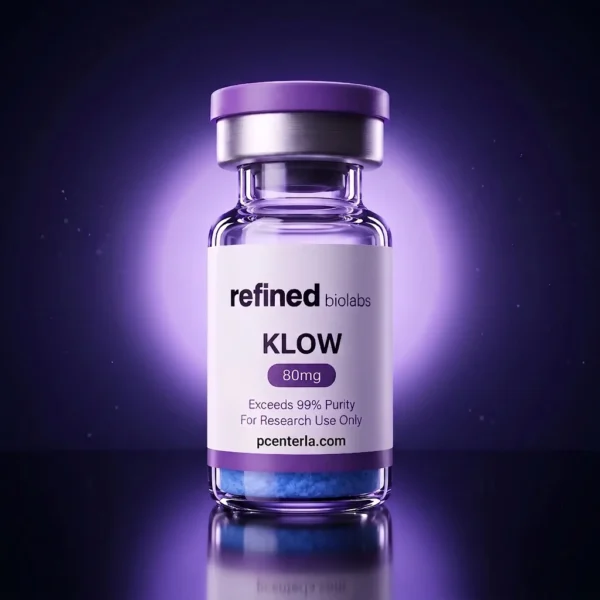
What Is the KLOW Peptide Blend?
KLOW is not a single molecule. It is a vendor-named combination of four chemically distinct research peptides sold together. The most commonly referenced laboratory format totals approximately 80 mg, with GHK-Cu as the largest component (around 50 mg) and roughly 10 mg each of BPC-157, TB-500, and KPV. The four peptides remain separate compounds when mixed; they do not form a new chemical entity. No controlled study of the four-peptide combination itself appears in the published literature as of late 2026. All available data relate to the individual peptides examined separately, primarily in cell culture or animal models.
KLOW Standard Research Composition
Typical research vials list:
- GHK-Cu (copper tripeptide)
- BPC-157 (15-amino-acid synthetic peptide)
- TB-500 (acetylated thymosin β-4 fragment)
- KPV (tripeptide fragment of α-MSH)
Exact ratios can vary by supplier. Researchers should request a current certificate of analysis (COA) confirming identity, purity, and quantity for each component.
KLOW Individual Component Research Context
Each peptide in the KLOW research blend has its own body of preclinical literature. The blend itself has not been tested as a unit in any published animal or human study.
GHK-Cu in Laboratory Models
GHK-Cu is a naturally occurring copper-binding tripeptide studied in fibroblast cultures and animal wound models for its association with extracellular-matrix gene expression, collagen-related pathways, and copper delivery to enzymatic processes.
BPC-157 in Preclinical Work
BPC-157 is a synthetic pentadecapeptide examined mainly in rodent models of soft-tissue and gastrointestinal injury for effects on cell migration, angiogenesis signaling, and local tissue responses.


Reviews
There are no reviews yet.