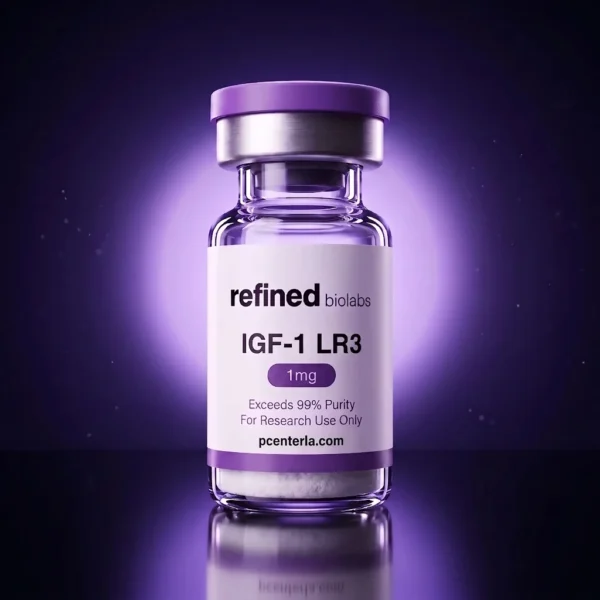
IGF-1 LR3 (Long R3 Insulin-like Growth Factor-1, also written LR3-IGF-I or Long Arg3 IGF-1) is a synthetic recombinant analog of native human IGF-1. Native mature IGF-1 contains 70 amino acids. IGF-1 LR3 extends this to 83 amino acids through two deliberate modifications: a 13-amino-acid N-terminal extension (commonly MFPAMPLSSLFVN) and substitution of arginine for glutamic acid at position 3 of the IGF-1 sequence. These changes substantially reduce affinity for the six circulating IGF-binding proteins (IGFBPs 1–6) while largely preserving binding and agonist activity at the type-1 IGF receptor (IGF-1R). As a result, a higher proportion of the molecule remains free and available to activate receptors in experimental systems, making IGF-1 LR3 a preferred reagent over native IGF-1 in many cell-culture and signaling applications.
In laboratory settings, IGF-1 LR3 functions as a potent mitogen. It is widely used in serum-free media formulations to support cell proliferation and survival, particularly in fibroblast, epithelial, myoblast, and other cell lines. Upon binding IGF-1R, it triggers receptor autophosphorylation and downstream cascades, including the PI3K/Akt/mTOR pathway (linked to protein synthesis, cell survival, and growth) and the Ras/MAPK/ERK pathway (associated with proliferation and differentiation). Researchers employ it in assays measuring DNA synthesis, protein synthesis, myotube formation, receptor phosphorylation, and related readouts. Preclinical animal and cell studies have examined its effects on muscle protein synthesis, lean mass parameters, and metabolic responses, though results vary by model and conditions. Importantly, there are no published human clinical efficacy or safety trials of IGF-1 LR3; all available data are preclinical or in-vitro.
IGF-1 LR3 is not approved by the FDA or any major regulatory authority for human therapeutic use. It is sold exclusively as a research chemical for laboratory, in-vitro, and preclinical research purposes. Native recombinant human IGF-1 (mecasermin) is a different molecule with its own approved pediatric indications and distinct pharmacology. IGF-1 and its analogs are prohibited at all times under the World Anti-Doping Agency (WADA) list. Quality varies widely in the marketplace; researchers should prioritize suppliers that provide batch-specific HPLC purity testing (typically targeting ≥98–99%), mass spectrometry identity confirmation, endotoxin screening where relevant, and full Certificates of Analysis.
When sourcing IGF-1 LR3 for your laboratory, look for transparent documentation, proper lyophilized presentation, and clear research-only labeling. Typical research vial sizes start at 1 mg. Store lyophilized material according to supplier recommendations (commonly frozen and protected from light and moisture) and reconstitute under sterile conditions appropriate to your protocol. Whether your work focuses on IGF-1R pathway dissection, comparative potency studies versus native IGF-1, serum-free culture optimization, or muscle-cell biology models, high-purity IGF-1 LR3 provides a well-characterized tool for controlled experiments. Explore our independently tested research-grade IGF-1 LR3 today and support rigorous, reproducible science. Always handle research peptides in accordance with institutional biosafety guidelines and applicable regulations. This product is strictly not for human or veterinary use.
Reviews
There are no reviews yet.